Pool Cage Painting Sarasota FL
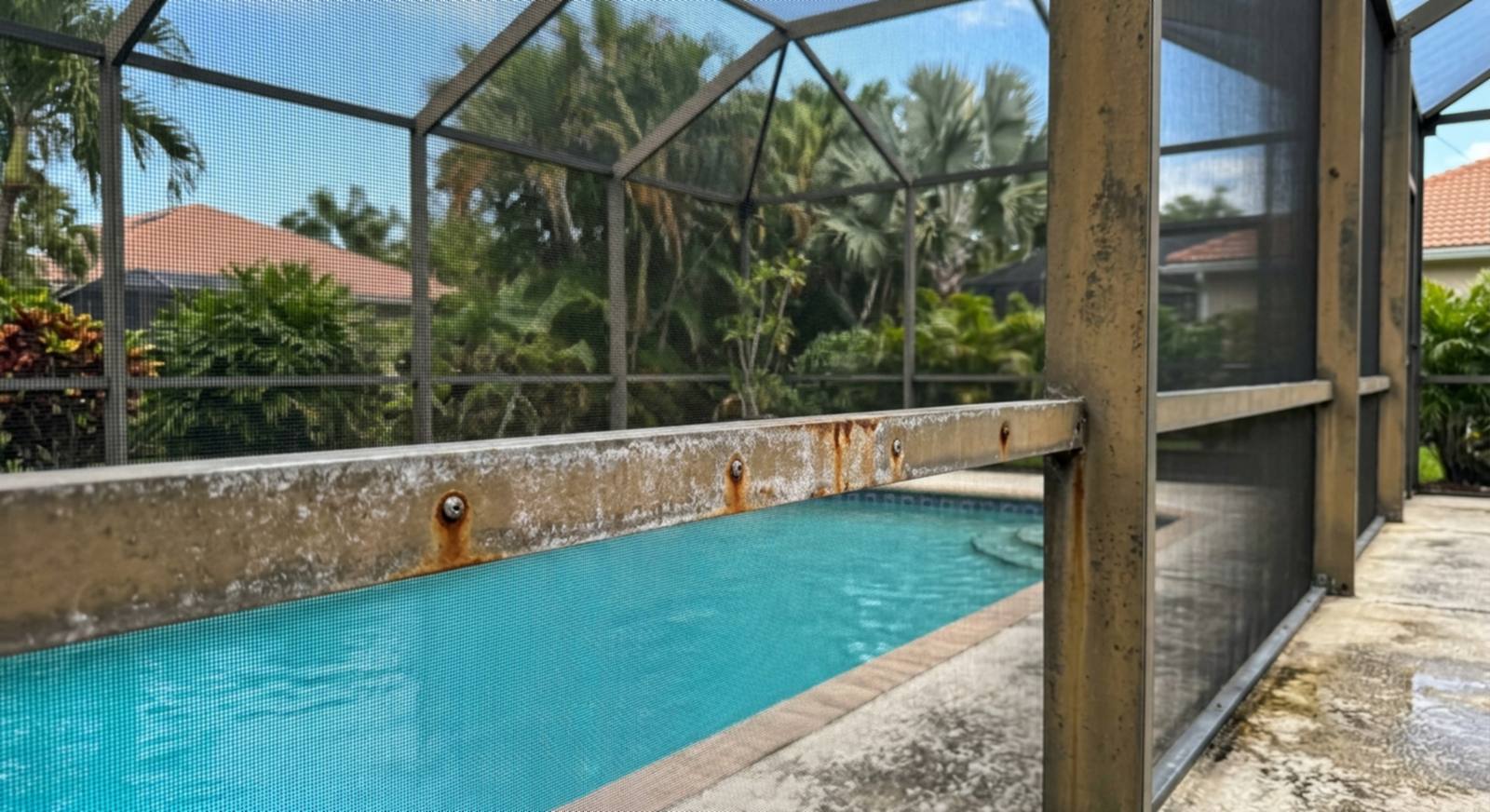
Chalky, faded, or rust-streaked frames brought back without replacing the structure. Free on-site look and a written price before anything starts.
Call (941) 541-6567Free painting quote
Tell us what the frame looks like and we'll come price it.
Quick answer: Pool cage painting is a field repaint of the aluminum frame on a cage that is structurally sound but chalky, faded, or streaked with rust. The screen comes out, the frame is cleaned and coated, and a good repaint in Sarasota generally holds for five to ten years. It costs a fraction of replacing the structure.
When a cage needs paint and not replacing
Most tired-looking cages are not failing. They are just weathered. The giveaway is that the frame is still straight and solid, the base plates are sound, and what has actually gone is the finish. You will see a chalky powder that comes off on your hand, color that has faded unevenly on the sunny side, and thin rust streaks running down from the screw heads.
None of that is structural. A frame in that condition is a repaint, and quoting it as a rebuild is one of the more expensive mistakes a homeowner can be talked into. If you want the full decision framework on where that line sits, our rescreen or rebuild guide lays it out.
What Florida salt air actually does to the finish
Aluminum protects itself with a thin oxide layer, and out here that layer is under constant attack. Airborne chloride off the Gulf carries a long way inland, and the finishers who coat architectural aluminum for a living note it turns up more than fifty miles from the shore. On unprotected aluminum the chemistry overwhelms that oxide layer and you get visible pitting. It concentrates wherever moisture sits, which is why joints and screw holes go first.
The coating fails in two ways the industry actually grades. Chalk is the finish breaking down into powder. Fade is the color shifting. The AAMA specifications rate coatings by real South Florida exposure, at one, five, or ten years of color retention depending on grade. Worth knowing, because it sets an honest ceiling on what any finish does in this climate.
A cage a few streets from the water in Siesta Key or Bird Key ages faster than the same cage inland at Lakewood Ranch. Same paint, different chemistry hitting it.
How pool cage painting actually works
The order matters more than the product. Clean first, and properly. Paint manufacturers specify solvent cleaning to strip oil and grease before anything else touches the metal, and every coating failure I have seen traced back to somebody skipping that.
Then the chalk has to come off, because fresh coating over loose powder is just a film sitting on dust. Corroded spots get dealt with individually rather than painted over. Only then does the coating go on, and on aluminum a direct-to-metal acrylic system is the common route, applied in two coats to a real film thickness rather than one thin pass.
Application is where a cage differs from a wall. Manufacturers permit brush and roller, and on flat surfaces either is fine. A cage is hundreds of feet of narrow extrusion, much of it overhead, and a roller leaves lap marks down every run. Spray gives an even film. It is also why this is not a Saturday project.
Powder coating a cage that is already standing
This one deserves a straight answer, because the term gets used loosely and it costs people money.
You cannot powder coat a cage that is already up. Powder coating is an electrostatic process followed by an oven cure, typically somewhere around 390 degrees for ten to fifteen minutes. That happens to extrusion at the factory, before your cage was ever assembled in your back yard. It is also why the AAMA performance grades are written for factory-applied coatings.
So if someone quotes you powder coating for the cage standing outside your house, they are either describing a spray repaint using the wrong word, or they are quoting you a new frame. Worth asking which.
Worth knowing that some companies sell a service called powder coat restoration. That is a field-applied liquid coating, not factory powder coating, and the two are different processes with different service lives. It is not automatically bad work and plenty of it is done well. It just means two quotes that look the same on paper might not be the same job at all, so ask which process you are actually buying before you compare the numbers.
| Option | Where it happens | Possible on a cage that is already up? | Relative cost | Service life |
|---|---|---|---|---|
| Factory powder coat | At the extruder, before your cage was ever built | No. It needs an oven. | Comes with new framing | Longest, and it is what the AAMA grades measure |
| Field repaint | On site, on the cage you already own | Yes. This is the only option for a standing cage. | Well under a rebuild | Roughly five to ten years here |
| Full frame replacement | New extrusion, new structure | Yes, but you are buying a cage, not a finish | Highest by a distance | Longest, because everything is new |
Does the screen have to come out?
For a proper job, yes. Spray gets everywhere, and mesh catches it. The screen and the spline come out, the surrounding areas get masked, and the frame gets coated clean.
Which leads to the thing most people work out halfway through the quote. If the screen is coming out anyway, putting the same tired mesh back against a freshly finished frame is a strange choice. Painting and rescreening get done together more often than not, and the labour overlaps, so doing both at once costs less than doing them a year apart.
Color, and the one that is harder than it looks
Bronze, white, and almond cover almost everything here. Going darker is straightforward. Bronze back to white is the one that surprises people, because light over dark takes more coats to cover evenly, and that shows up in the price.
How long a repainted cage lasts here
Five to ten years is the honest range, and where you land inside it is mostly about how close you are to open salt water. I would not tell you a field repaint matches a factory finish, because the AAMA grades that people quote are written for coatings applied in a controlled plant, not on a ladder in your yard. Anyone promising you twenty years on a repaint is selling.
What extends it is unremarkable. Rinse the frame occasionally and do not let corroded spots sit. Our cleaning and maintenance guide covers the rest.
When painting is the wrong call
Paint is a film over metal. It does not put material back. Where salt has pitted a member through, or a base plate has corroded away where it meets the deck, coating it makes the cage look fixed while the structure keeps losing ground. That is a pool cage rebuild, and we will say so rather than take the easier job.
The things that disqualify a cage from a repaint, in the order we usually find them:
- Base plates corroded through at the deck, often with rust bleeding down into the concrete around them
- Fastener holes that have gone oval, so a screw spins instead of biting
- Aluminum you can push a screwdriver through, rather than surface pitting you can feel with a fingernail
- A beam or upright out of line, which is a structural problem paint cannot see
- Sections previously repaired with the wrong fasteners, where the metal around each screw is already going
The honest test on site is whether the aluminum still has its section. Surface corrosion cleans up and coats fine. Corrosion that has eaten through does not, and no coating changes that.
If some of the frame is sound and some of it is not, a partial rebuild plus a repaint of what remains is usually the answer rather than one or the other. Our rescreen or rebuild guide walks the same line from the screen side.
What moves the price
We quote every pool cage painting Sarasota FL job on site because the spread is genuinely wide. What drives it: the size of the enclosure and how many panels it has, the roof style and the height, whether there are two-story or mansard sections that need staging, how far the old finish has degraded, how many corroded spots need individual attention, whether the screen is being replaced at the same time, and how easy the cage is to work around.
The comparison that actually helps: a repaint on a sound frame costs far less than replacing that frame. For what the other work runs, our Sarasota pool cage cost guide has real ranges.
Where we work
Sarasota County and the surrounding communities. Sarasota, Siesta Key, Bird Key, Lido Key, Longboat Key, Casey Key, Osprey, Nokomis, Venice, Lakewood Ranch, Palmer Ranch, Gulf Gate, Bradenton, North Port, and Englewood.
Can a pool cage be painted?
Yes, as long as the frame is structurally sound. Painting is a finish fix, not a structural one. If the aluminum is pitted through or a base plate has corroded away, paint hides the problem instead of solving it, and that job is a rebuild.
How much does it cost to paint a pool cage?
Far less than replacing the frame, and that is the comparison that actually matters, because a repaint and a rebuild are the two roads open to a tired-looking cage and only one of them involves buying new aluminum. Our Sarasota cost guide carries the rebuild ranges so you can see the size of that gap for yourself. What moves the repaint number is the size and panel count, the roof style and height, two-story or mansard sections, how far the old finish has gone, and whether the screen is coming out. We price it on site in writing, free.
What type of paint is used on a pool cage?
A direct-to-metal acrylic system is the common route on aluminum, and manufacturers like Sherwin-Williams list it as self-priming on aluminum applied in two coats. Where the topcoat is an epoxy or urethane, a wash primer is used as a tie-coat first. What matters more than the brand is that the surface is genuinely clean and dry before anything goes on.
Can you paint a white pool cage bronze?
Yes. Going darker is the easier direction and it is the most common change people ask for. Going from bronze back to white takes more coats to cover properly, so expect that to price differently.
Does the screen have to come out to paint the frame?
In practice, yes for a proper job. Spray is what gives an even finish on hundreds of feet of narrow extrusion, and spray means overspray. Since the screen and spline are coming out anyway, most people put new screen back in rather than reinstalling old mesh next to a fresh frame.
Chalky, faded, or streaked with rust?
Free on-site look and a written price across Sarasota County.
Call (941) 541-6567