Quick answer: Florida pools are screened in mostly to keep out bugs and debris. The screen stops mosquitoes and no-see-ums, keeps leaves and pollen out of the water, filters some of the harsh sun, and keeps frogs, lizards, and other critters from getting in. A cage can also serve as the safety barrier the state requires around a pool. Put together, that's why almost every pool down here has one.
Drive through any Sarasota neighborhood and you'll see it: nearly every backyard pool sits inside a big screen enclosure. People moving here from up north almost always ask why. It's not just for looks. Each reason below solves a real Florida problem, and most cages are earning their keep on all of them at once.
Reason one: the bugs
This is the big one. Florida heat and humidity make it paradise for mosquitoes and no-see-ums, those tiny biting midges that slip through a regular window screen. Without a cage, sitting by the pool at dusk means getting eaten alive. A screen enclosure lets you swim, grill, and hang out in the evening without the bug spray and the bites. If you've ever wondered why the screen has such a tight weave, that's the no-see-ums. Ask anyone who's spent a summer evening outside here and they'll tell you the cage is worth it for the bugs alone.
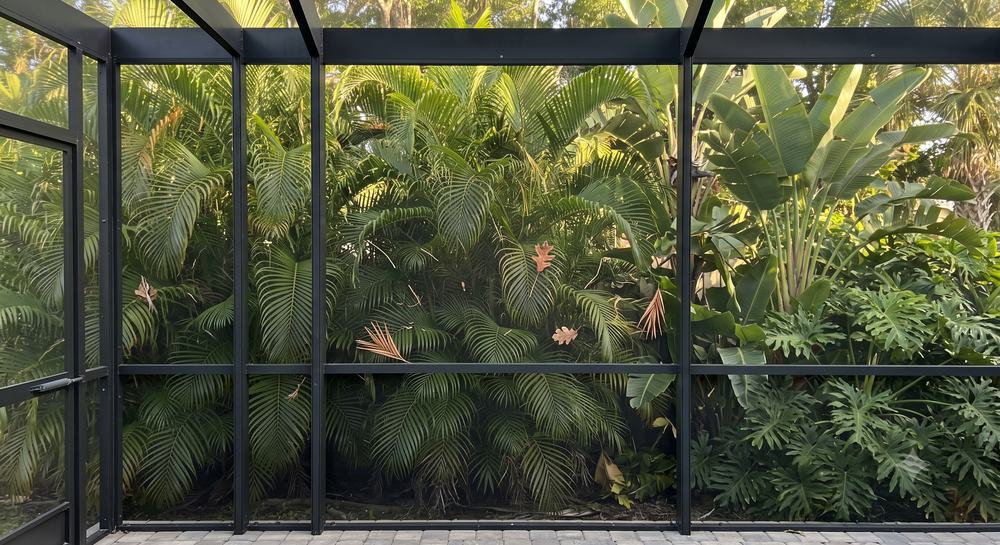
Reason two: leaves, pollen, and a cleaner pool
A pool cage is a giant filter for everything that falls out of the sky. Live oaks, palms, and pines drop leaves, fronds, and pollen all year, and Gulf Coast storms fling all kinds of trash around. The screen keeps most of it out of the water. That means less time skimming, less strain on the pump and filter, less algae, and fewer chemicals to keep the water clear. Skipping the cage to save money usually costs more over a few years in cleaning time and chlorine than the screen ever would. A screened pool is just less work, plain and simple.
Reason three: the sun
Our sun is no joke, and the screen takes the edge off it. A standard pool screen filters a good chunk of the UV and cuts the glare off the water. The deck stays a little cooler, and you get some relief without losing the open, breezy feel. It doesn't make the pool dark. If you want more shade and privacy, a denser solar or privacy mesh does more of that, which our screen guide covers.
Reason four: safety and the pool barrier law
There's a legal side too. Florida's Residential Swimming Pool Safety Act requires a residential pool deeper than 24 inches to have at least one approved safety feature. A screen enclosure can be that barrier. To count, it has to be at least four feet high, with no gaps a small child could squeeze through. The gate has to swing away from the pool, with a latch up high out of a child's reach. If doors or windows from the house open into the enclosure, you also need alarms on those. You can read the actual law in the Florida Statutes, Chapter 515. So for a lot of homes, the cage does double duty. It keeps the bugs out and satisfies the barrier rule at the same time.
Reason five: the critters
Florida wildlife is part of the charm and part of the reason for the screen. Frogs, lizards, and toads love a pool, and a screen keeps them out of the water and out of the skimmer. Depending on where you live, it also helps with snakes and the odd raccoon. And yes, in some areas, it keeps a curious gator on its own side of the fence. For most Sarasota homeowners it's mainly frogs and lizards, but the cage handles all of it.
So why do people call them bird cages?
You'll hear folks call a pool cage a "birdcage," and it's just the shape. A tall enclosure with a peaked or domed screen roof looks like a giant birdcage set over the pool. It's the same structure, just a nickname. If you want the rest of the lingo, spline, mansard, kickplate, and the like, our pool cage glossary lays it all out.
Do you actually need one?
Legally, you're not forced to have a cage specifically. You need some approved safety barrier around the pool, and a fence can do that job instead. But practically speaking, almost every pool in Sarasota has a cage because of the bugs and the cleaning. Those two reasons alone win most people over. Say you've got a pool with no enclosure and you're tired of fishing leaves out and swatting mosquitoes. A cage is usually the upgrade that pays you back the most in day-to-day use. For what it runs, see our Sarasota cost guide.
Already have a cage that needs work?
Most of our pool cage repair work in Sarasota is keeping existing cages in shape. That is rescreening a pool cage in Sarasota when the screen goes brittle, or a few new panels after a branch comes down. It might be a new screen door, or a pool cage rebuild in Sarasota County when the frame itself is failing. If a storm did a number on yours, we handle storm and hurricane damage too. Call (941) 541-6567 or use the form above for a free written quote.
Common questions about Florida pool cages
One thing worth knowing before storm season: a cage is not hurricane proof, but it is engineered to a wind speed. Here is what a pool cage is actually wind-rated for and why the screen is built to let wind pass straight through.
Why do pools in Florida have cages?
Bugs, debris, sun, safety and critters, in that order of how often it comes up. Mosquitoes and no-see-ums are the main reason. The screen also keeps leaves and pollen out of the water so the pool needs less cleaning and fewer chemicals, cuts some of the UV, and can serve as the safety barrier Florida law requires around a pool deeper than 24 inches.
Is a pool cage necessary in Florida?
A pool cage isn't required by name. But a pool deeper than 24 inches must have at least one approved safety feature under Florida law, and a screen enclosure with a proper gate can be that barrier. Beyond the law, almost every Florida pool has a cage because it keeps out bugs and debris. That's more of a practical need than a legal one.
Why do people in Florida call them bird cages?
It's the shape. A tall pool enclosure with a peaked or domed screen roof looks like a giant birdcage over the pool. It's just a casual name for a screen enclosure, not a different structure.
Does a pool cage count as a safety barrier in Florida?
It can. Under the Residential Swimming Pool Safety Act, a screen enclosure can work as the required barrier. It has to be at least four feet high with no climbable openings, and the gate must swing away from the pool with a high latch. If house doors or windows open into the enclosure, those need alarms too.
Do pool cages keep the pool cleaner?
Yes, and it's one of the top reasons people keep them. The screen keeps leaves, pollen, and storm debris out. So you skim less, the pump and filter work less, there's less algae, and you use fewer chemicals.
What does a pool cage cost in Florida?
A full rescreen of an existing cage usually runs about $1,000 to $3,000. A brand new cage typically runs from around $8,000 into the $20,000s depending on size and style. Single-panel repairs are much less. Our Sarasota cost guide breaks each one down.