How to Prepare Your Pool Cage for a Hurricane in Florida
What actually protects a screen enclosure, sorted by when you do it. Most of it happens before a storm is ever named.
Call (941) 541-6567Post-storm free quote
Send us what happened and we'll prioritize you.
The short version: Preparing a pool cage for a hurricane is mostly work you do before anything is named: sound screen, solid fasteners, trimmed branches, and storm hardware you already own. In the last 72 hours you clear every loose object off the deck, kill the power to the pool equipment, and leave the pool full. Do not drain it.
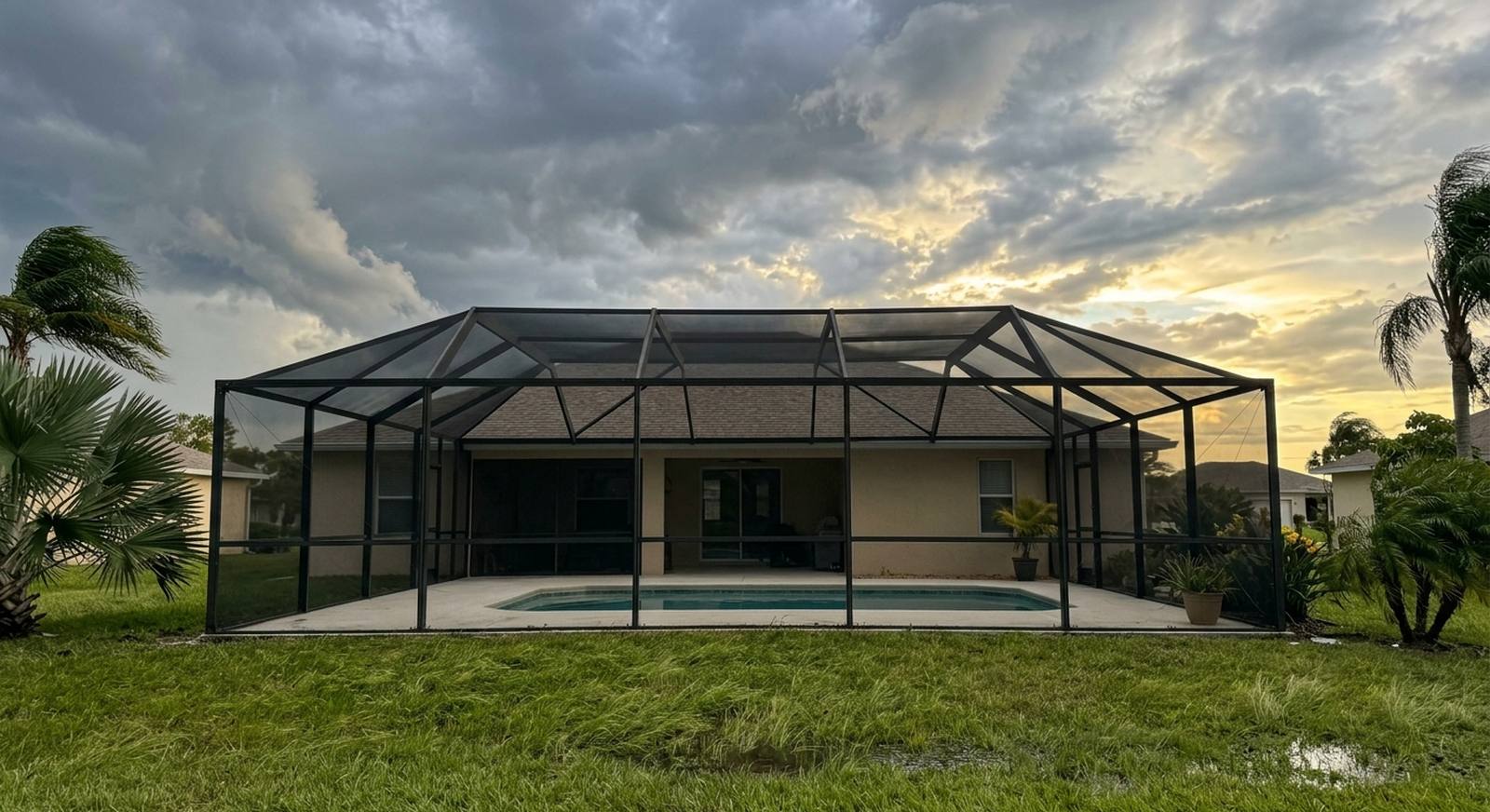
Timing, because it is August
The Atlantic season runs June 1 to November 30, and according to the National Hurricane Center the peak is September 10, with most activity between mid-August and mid-October. So if you are reading this the week it went up, you are sitting at the front edge of the busiest stretch of the year. That matters because almost everything genuinely useful you can do for a cage takes more than 24 hours, and the stuff you can do in 24 hours is mostly moving furniture.
Below is the honest version of how to prepare your pool cage for a hurricane, sorted by when you actually do it rather than as a list of seven tips.
Preparing your pool cage before anything is named
This is where the real protection lives, and it is unglamorous. Two things fail first on a Sarasota cage, and both are cheap to fix now and expensive to fix in October.
Brittle screen is the first. Sun-shot mesh tears in a gust, and once a panel is flapping it yanks on the frame far harder than tight screen ever does. If your screen crackles when you press it, you are not looking at a cosmetic problem, you are looking at a storm liability. That is a pool cage rescreening job in Sarasota, and it is worth doing before the season peaks rather than after.
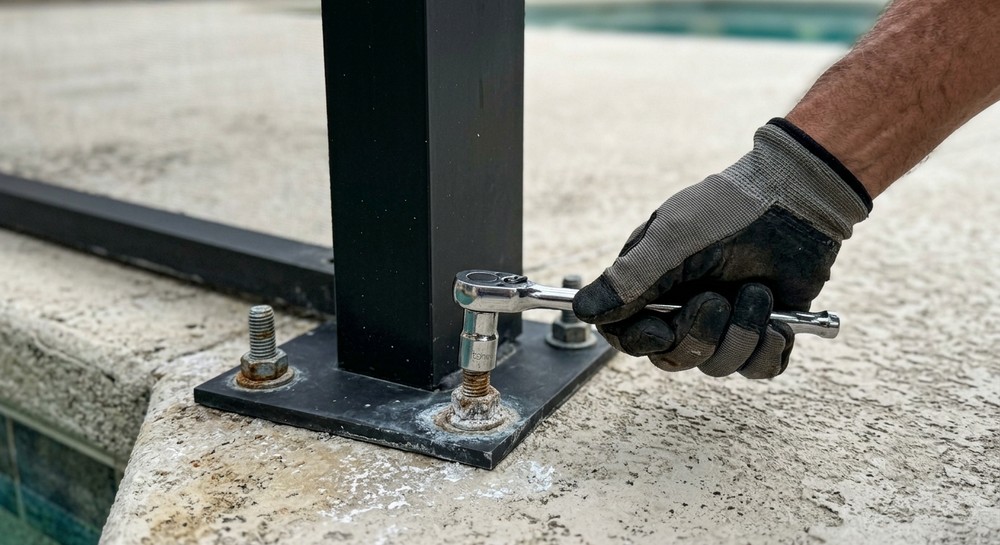
Corroded fasteners are the second, and around the water they go quietly. Salt air works on cheap screws until a screw that looks fine has nothing left in the threads. Walk the perimeter and put a screwdriver on the anchors at the base plates and the wall attachments. Anything rusted through or spinning free gets replaced, ideally with corrosion-resistant hardware.
Then look up. Overhanging branches are the single most common source of the debris that puts a hole in a cage, and trimming them back is free if you do it yourself and cheap if you do not. The National Hurricane Center is blunt about the general principle: loose material left outside becomes a flying missile in a hurricane.
72 hours out, once a storm has a name
Now you are working the deck, not the pool cage structure itself. Sarasota County's own preparedness guide says to remove loose items from outside the house and the yard and put them inside, and on a screened pool deck that means more than it sounds like.
- Chairs, side tables, loungers, and anything with a cushion
- Umbrellas and their bases, which are heavy enough to go through screen and frame
- Planters, solar lights, pool toys, skimmer nets, the robot
- The grill, if it lives under the cage
People underrate this because a pool cage feels like it contains things. It does not. A cage is a screen box, and a lounger tumbling around inside it will destroy more panels than the wind will.
This is also when you find out whether your storm hardware exists. If your cage was built with storm cables, the brackets and cables should already be on site. If you have been meaning to add them, three days out is too late, because that is exactly when the aluminum suppliers run out. Storm cable parts come from screen enclosure and aluminum suppliers rather than a hardware store, and the bracket has to suit your beam profile.
The screens question, decided early or not at all
You will hear that you should cut or pull your screen panels before a big storm. There is real engineering behind the idea. Florida Engineering LLC, a licensed engineering firm, puts the load reduction from removing under-truss screen panels at more than 40 percent generally and up to 60 percent on pool cages and screen enclosures. Their own recommendation, though, is to verify with your contractor that your structure is built to stay in place as is.
That is the part most people skip. Whether removal is right for your cage depends on how your cage was designed, and that is a question with an answer, not a coin flip. Some enclosures are engineered on the assumption the screen stays put. Some are not.
Here is the edged version. Deciding this at 10pm the night before landfall, with a box cutter and a headlamp, is not a strategy, it is panic with a blade. Ask your installer or a licensed contractor now, in August, which kind of cage you have and which panels come out if it comes to that. Then you either have a plan or you have a reason not to need one. If you want the structural background on why screen is porous in the first place and what the numbers mean, that sits in our guide to pool cage wind ratings.
One thing that is not in dispute: if you do pull panels, you are rescreening afterward regardless of what the storm does. Budget for it.
Your pool is not your cage, and the advice is different
Most cage owners get this backwards, so it is worth being plain.
Do not drain the pool. UF/IFAS Extension advises against draining or even partially draining ahead of a storm, because all the extra groundwater on the outside of an emptied shell can crack the pool, and in the version quoted by a UF/IFAS home educator, pop it up out of the ground and take the plumbing and decking with it. The Florida Swimming Pool Association says the same thing in fewer words. A full pool is heavy, and that weight is the point.
UF/IFAS adds a smaller trap worth knowing. Drain below the skimmer, then have the storm miss you, and you can burn up the pump motor for no reason at all.
Kill the power. FSPA's guidance is to turn off the breakers and cover the electrical equipment. Do that at the panel. Sarasota County's guide points people to the manufacturer's instructions for shutting down pool equipment, which is the right call if yours has anything unusual about it.
Skip the pool cover. A cover will not stop debris and it gives the wind something to grab.
The patio furniture argument, and where I land
Two credible Florida sources flatly disagree here, and none of the contractor pages on this topic will tell you that.
FSPA says that if patio furniture cannot be stored inside, you may gently place it in the pool, while avoiding scratching the finish and noting that pool chemicals may cause damage. UF/IFAS says do not, because the water and chemicals corrode the furniture and the reactions leave permanent staining in the pool finish.
Both are right about their own risk. My read for a screened Sarasota pool is that furniture in the pool is a last resort, not a plan. If you have a garage, a shed, or a room with a door, the furniture goes there. The pool is where it goes when you have run out of options and the alternative is a lounger loose inside your cage.
The morning after
Get the debris out before you switch anything back on. Then bring the water back to where UF/IFAS puts it, mid-way up the tile line or half-way up the skimmer, and get the chemistry balanced before anyone swims.
While you are out there, look at the cage properly in daylight. Torn panels are obvious. What people miss is the frame: a beam pulled slightly out of line, a base plate lifted at one corner, screws backed out along one side. Screen damage on its own is a rescreen. Frame movement is not, and the honest line between the two is covered in our rescreen or rebuild guide. If a storm has already been through, storm and hurricane damage repair is where to start, and photograph everything before you touch it, because the insurance guide explains why that matters.
What nobody can honestly tell you
You will find pages quoting a percentage of cages that failed in a named storm. There is no published post-storm study behind those numbers that I can find, and I looked. Nobody has produced a public assessment of how screen enclosures performed in Ian, Milton, or Idalia. Anyone giving you a figure is making it up, and a made-up number is a bad reason to spend a few thousand dollars.
What is real is the boring stuff. Sound screen on the pool cage, solid fasteners, nothing loose on the deck, no branches overhead, and a plan you made in August rather than a decision you make at midnight.
What homeowners ask next
Is it too late to get a rescreen before the peak? Not in early August, and it gets harder every week after. Once a storm is named the whole industry books solid, so the window is now rather than September.
Does any of this change if my cage is older? Yes, in the sense that an older cage has more to lose from brittle screen and tired fasteners. Age itself is not the problem. Untouched age is.
Should I add storm cables? Worth asking a licensed contractor about for your specific cage, in the off season. It is a design question, not an accessory you bolt on in a hurry.
Who do I call to get the cage looked at before the season peaks? Us, if you are in Sarasota County. It is a free on-site check and a written price, and if the answer is that your cage is fine, that is what we will tell you.
Should you turn off the pool pump during a storm?
Yes. The Florida Swimming Pool Association tells homeowners to turn off the breakers and cover the electrical equipment before a storm. Do it at the breaker panel, not just at the timer, and leave it off until the power is stable again.
Should I drain my pool before a hurricane?
No. UF/IFAS Extension advises against draining or even partially draining, because groundwater pressing on an emptied shell can crack the pool or push it out of the ground. A full pool is heavy, and that weight is what holds it down. If rain overfills it, bring the level back down afterward.
Where do you get storm cable brackets for a pool cage?
They come from aluminum and screen enclosure suppliers rather than the big box stores, and the bracket has to match your beam profile. This is worth sorting out in June rather than the day a storm is named, because that is when suppliers run dry.
What do I do with the pool after a hurricane?
Clear the debris out before you run anything, then bring the water back to about mid-way up the tile line or half-way up the skimmer, which is where UF/IFAS says it should sit. Get the water balanced again before swimming. Look over the cage frame and fasteners in daylight while you are out there.
Get your cage checked before the next one
Free on-site look at the screen, fasteners, and frame across Sarasota County.
Call (941) 541-6567