Short answer: A panel or two you can reach standing on the deck is a fair DIY job, and the materials are cheap. A whole cage is a different animal. Once the panels are over your head, the spans get wide, and the old screen starts tearing as you work next to it, the time and the risk climb faster than the savings do. Price the job both ways before you buy a roll of screen.
Every year a few people ring us halfway through. They started with one torn panel by the door, it went fine, so they carried on around the cage. Then they hit the high panels on the sloped roof and the whole thing stopped being fun. There is nothing wrong with doing this yourself. It just helps to know where the line sits before you are up a ladder with a knife in your hand.
What a DIY pool cage rescreen actually costs in materials
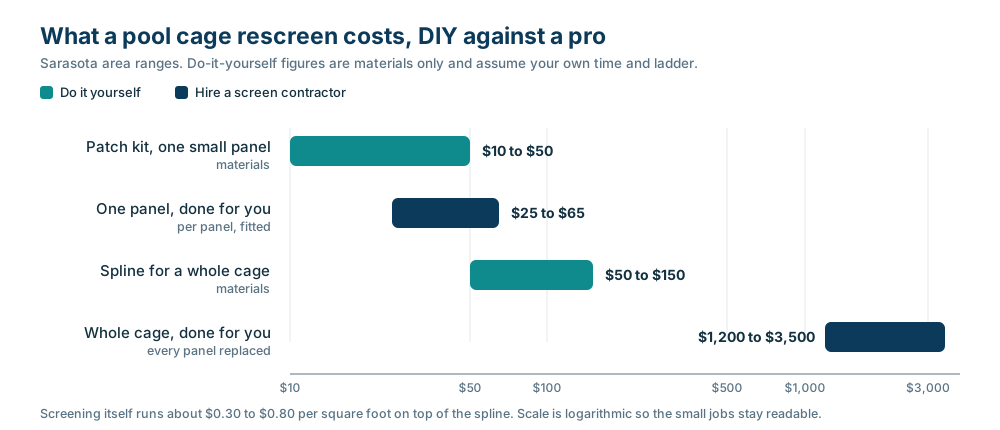
Materials for a whole cage usually land in the low hundreds of dollars. Fiberglass screening is commonly sold around $0.30 to $0.80 per square foot depending on grade and roll width. Spline for an average pool cage runs roughly $50 to $150. Small patch kits sell for about $10 to $50. Add a spline roller and a pack of blades and you are still well under what a contractor charges.
That gap is real and nobody should pretend otherwise. A professional full-cage rescreen around Sarasota generally runs about $1,200 to $3,500. So the honest framing is not that DIY is a trap. It is that you are buying back a weekend or three, plus the ladder work, plus somebody else carrying the risk if a panel goes wrong. Our Sarasota pool cage repair cost guide has the full breakdown by job type.
| What you are paying for | Doing it yourself | Hiring a screen contractor |
|---|---|---|
| Screening and spline | Roughly a few hundred dollars for a full cage | Included |
| Tools | Spline roller, knife, blades, a stable ladder | Included |
| Your time | A weekend for a few panels, considerably more for a cage | Usually one visit |
| Height work | Yours to manage | Theirs |
| Old screen disposal | Yours to haul | Normally taken away |
| If a panel comes out wrong | You buy the screen again | They redo it |
The tools you need, and the one that decides the result
The kit is short: a spline roller, a sharp utility knife with spare blades, something flat to lift the old spline out of the channel, new screening, new spline in the right diameter, and a ladder you actually trust. That is it. Nothing on that list is expensive or hard to find.
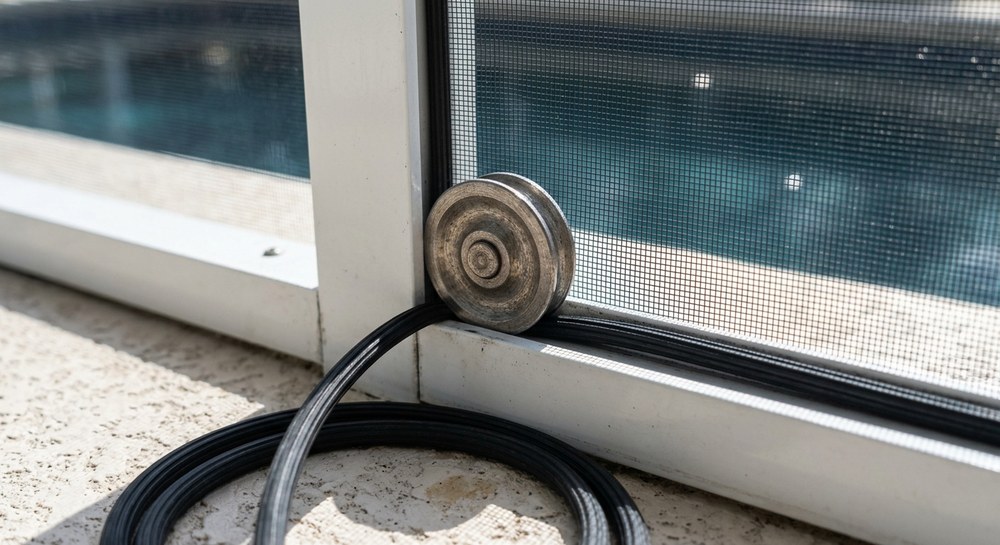
The spline roller is the tool that decides how the job looks in six months. It is a small wheel on a handle, and it presses the spline into the frame channel with the screen trapped underneath. How hard you pull the mesh before the roller goes down sets the tension. Too loose and the panel ripples, then relaxes further the first time the sun heats it. Too tight and you pucker the corners and put a slight bow in a light frame member. Even tension across a wide span is the actual skill here, and it is the bit that takes repetition rather than equipment.
One detail people miss: spline comes in different diameters. Pull a short piece out of an existing channel and take it to the counter with you. Guessing the size is how a panel ends up either impossible to seat or loose enough to walk back out.
When rescreening a panel yourself is genuinely worth it
Low, small and reachable is the sweet spot. If the dog went through the kick panel again, or a chair leg caught the mesh beside the door, that is a genuine DIY job and you should not pay someone to drive out for it. Same for a single torn panel at deck level that you can work on with both feet on the ground.
Those panels are also the ones that fail most often, which is worth knowing. The bottom row takes the traffic, the pets and the furniture. If your cage is otherwise sound and it is always the same two panels, learning to do them yourself is a sensible piece of homeownership. Keep a spare roll in the garage and it becomes a twenty minute job.
Where DIY stops making sense on a Florida pool cage
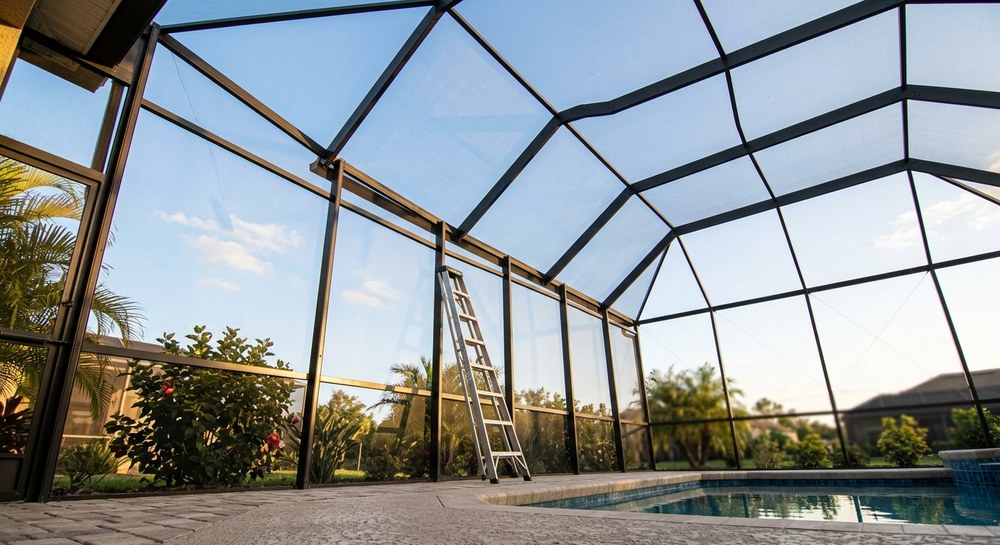
Height is the first hard limit. A lot of the cages around Palmer Ranch, Lakewood Ranch and the older Sarasota neighborhoods are mansard or gable shaped, which means the biggest panels sit on a slope well above the deck. Working screen on a sloped panel from a ladder is a different job to working one at chest height, and it is where people get hurt. Two-storey cages take it further out of reach again.
The second limit is one nobody warns you about. On a cage where the screen has aged out, the mesh has gone brittle from years of sun, and brittle mesh tears when it is disturbed. Pull the spline out of one panel and the neighbouring panel will often let go along its edge as it flexes. So the person who set out to replace two panels finds themselves replacing five, and each one is a fresh trip up the ladder. If your screen crackles when you press it, assume the job will grow. Our guide on how long pool cage screen lasts in Florida covers what that brittleness means.
Third, there is the frame. A rescreen only makes sense on aluminum that is still sound. If the base plates are corroded or an upright flexes when you push it, new screen is money wrapped around a failing structure. Check that before you buy anything, and our rescreen or rebuild decision guide walks through how to tell.
Screen kits from the big box store: what you are actually buying
A patch kit is fine for a patch. For a whole cage, look at the mesh grade rather than the price. Most Florida pool cages use standard 18/14 fiberglass, which means eighteen strands one way and fourteen the other. Lightweight window mesh sold off the same aisle is a different product and it will not take the sun and wind loading a cage puts on it. Manufacturers such as Phifer publish the specifications, so you can check what you are holding.
Roll width matters too. A cage panel can be wide, and joining two pieces of mesh inside one panel never looks right and never holds tension properly. Measure your widest panel before you buy, then buy a roll that covers it. If you are weighing up mesh types while you are at it, our guide to the best pool cage screen for Florida compares standard fiberglass, no-see-um, pet-resistant and Florida Glass.
What you are paying a professional for, beyond the labor
The obvious answer is that someone else goes up the ladder. The less obvious parts are where the money actually goes. A crew rescreening a cage carries the right spline sizes for every channel on the structure, cuts with almost no waste, hauls the old mesh away, and reruns a panel that is not right without charging you for the screen twice.
There is also the matching problem. Rescreening half a cage yourself and half later leaves you with two mesh batches that read as different shades in flat afternoon light. Doing the whole thing in one go with one roll avoids that. It is a small thing until you are looking at it every day. See our Sarasota pool cage rescreening service for how a full-cage job runs.
Here is the opinion, and it is not the one you would expect from a company that sells rescreens. Do not pay us for one low panel you can reach. Pay us for the cage. The value we add is concentrated in exactly the parts of this job that are awkward, high and repetitive, and there is nothing clever about the easy panel by the door.
What homeowners ask next
Can I do the low panels myself and have someone do the high ones? Yes, and people do. Say so when you ask for a quote so the price reflects the actual panel count. Be aware that a mixed job can show a slight shade difference if the mesh comes from different batches.
Will a DIY rescreen affect an insurance claim later? Screen work you did yourself does not void a policy, but a claim is assessed on the damage and your deductible, not on who fitted the mesh. Our Florida pool cage insurance guide covers what is usually covered and what is not.
Do I need a permit to rescreen my own pool cage? Replacing screen in an existing frame is maintenance rather than structural work. Rebuilding or altering the structure is a different matter and belongs with a licensed contractor who can pull the permit. Our guide on choosing between a handyman and a licensed pool cage contractor explains why that distinction matters.
How long does a professional rescreen take? Most standard cages are a one-day job for a crew, sometimes two on a large or two-storey structure. That comparison is worth making honestly against the several weekends a full DIY cage tends to swallow.
Common questions about DIY pool cage rescreening
Can I rescreen my pool cage myself?
You can, and for one or two panels you can reach from the deck it is a reasonable weekend job. The tools are cheap and the method is simple. Where it gets hard is height, panel size and screen tension. A full cage means dozens of panels, most of them well above your head, and every one has to be pulled tight and even or it sags within a season.
How much does it cost to rescreen a pool cage yourself?
Materials alone usually run a few hundred dollars for a whole cage. Fiberglass screening is commonly quoted around $0.30 to $0.80 per square foot, spline for an average cage runs roughly $50 to $150, and small repair kits sell for about $10 to $50. A professional full-cage rescreen in Sarasota generally runs about $1,200 to $3,500, so the gap you are buying is labor, height and time.
What tools do you need to rescreen a pool cage?
A spline roller, a sharp utility knife with spare blades, a flat screwdriver or spline tool to lift the old spline, screening cut to size, new spline in the right diameter, and a stable ladder. The spline roller is the one that decides the result, because it is what sets the tension as the spline goes into the channel.
Is a DIY screen kit good enough for a Florida pool cage?
For a patch on a small panel it is fine. For a whole cage, check what mesh grade you are buying. Standard 18/14 fiberglass is what most Florida cages use, and cheap lightweight mesh sold for windows will not hold up to the sun and the wind the way cage screening does. Also match the spline diameter to your frame channel rather than guessing.
Why does DIY pool cage screen sag after a few months?
Almost always tension. Screen that goes in loose looks acceptable on the day and relaxes further once the sun heats it. Screen pulled too hard bows the frame member slightly and puckers at the corners. Even tension across a big panel is the skill in this job, and it is the part that takes practice rather than tools.