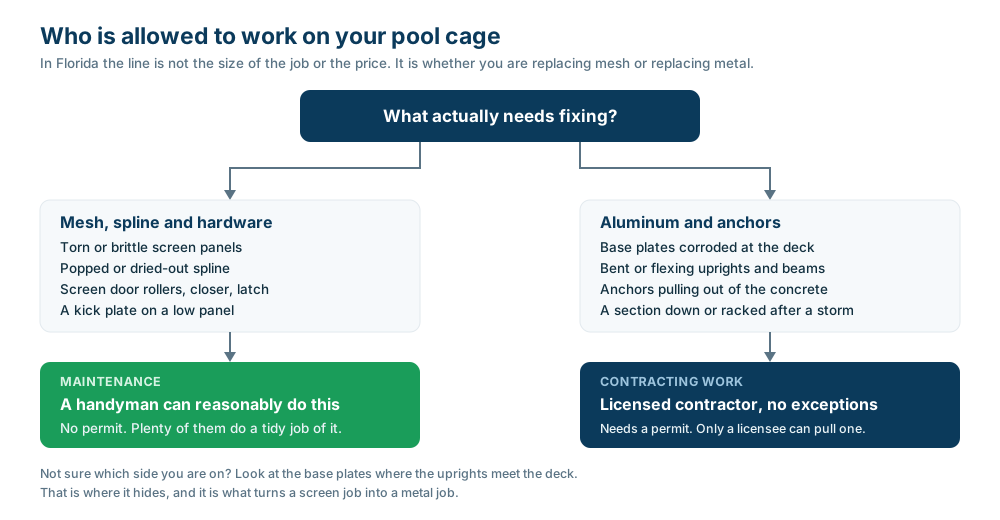
Bottom line first: Screen inside an existing frame is maintenance, and a good handyman can do it. Anything that touches the structure is contracting work, and Florida requires a license for that. The dividing line is not the size of the job or the price. It is whether you are replacing mesh or replacing metal.
This one gets argued badly on both sides. Half the advice online treats every handyman as a con artist, which is not fair to the people who do careful work for a living. The other half pretends the license is paperwork. Neither is right, and the honest version is easy enough to explain across a kitchen table.
What Florida law says about contracting without a license
Florida treats unlicensed contracting as a criminal offense, not a technicality. Under Florida Statute 489.127, acting as a contractor, or advertising yourself as available to, without being registered or certified is a first degree misdemeanor on a first violation. A second violation after a prior conviction becomes a third degree felony.
Here is the part that matters more in Sarasota than almost anywhere. If that violation happens during a declared state of emergency, it is a third degree felony regardless of whether the person has any prior conviction at all. That provision exists because of exactly what happens here after a storm, when unfamiliar trucks appear in the neighborhood offering to fix cages for cash. Our storm and hurricane damage repair page covers what to do in that window.
How to check a Florida contractor license in two minutes
Ask for the license number and the exact name it is held under, then look it up on the Florida Department of Business and Professional Regulation license search. It is free and it takes less time than reading a review.
Check the name, not just the number. A license belonging to somebody who is not on your job is the version of this problem that catches people out, because the number checks out fine and the person holding it has never seen your property. Screen enclosure work in Florida is normally carried out under a specialty contractor license, so if the category on screen is not obvious, ask which one covers the work being quoted. A contractor who does this for a living will answer that in one sentence.
The screen work a handyman can reasonably handle
Plenty. Replacing mesh in an existing frame is maintenance, and a handyman who owns a spline roller and takes their time can do a tidy job of it. Same for adjusting a dragging screen door, swapping worn rollers, replacing a door closer, or fitting a kick plate. None of that alters the structure.
If someone has looked after your house for years and they offer to sort two torn panels, that is a reasonable thing to say yes to. We would rather say that plainly than pretend every job needs a licensed crew. If you want to understand the work first, our guide on doing a pool cage rescreen yourself versus hiring it out covers the tools and where the difficulty actually sits.
Where a handyman job on a pool cage goes wrong
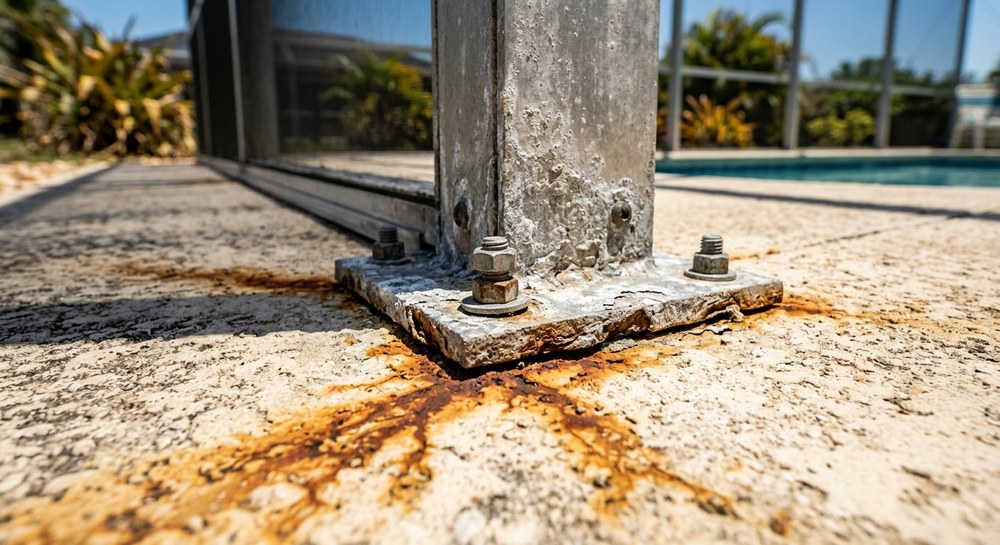
The trouble starts when a screen job turns out to be a metal job. That happens more often than people expect, because the failures hide at the bottom of the structure where nobody looks.
- Base plates corroded through at the deck, which means anchors and uprights, not mesh
- An upright or beam that is bent, bowed, or flexes under hand pressure
- Anchors pulling out of the concrete, or a super gutter separating from the frame
- A section that racked out of square in a storm and needs bringing back to code
- Any repair that requires a permit, which an unlicensed person cannot pull
That last one is the practical trap rather than the legal one. Unpermitted structural work sits on your property, not the installer's, and it tends to surface years later during a sale or an inspection. Our rescreen or rebuild guide shows how to tell which side of the line your cage is on before anyone quotes it.
Pool builder or rescreen specialist: who actually does this work?
Different trades, and people mix them up constantly. A pool builder builds and services the pool. The cage over it is a separate aluminum structure, and it is normally designed, built and repaired by a screen enclosure contractor. The two businesses sit next to each other on the same deck and do almost nothing in common.
Some larger firms genuinely do both, and there is nothing wrong with that. What you want to know is whether the screen side is handled in-house or passed to somebody else. If it is subcontracted, you are hiring a company you have not met, on a job you cannot easily inspect, through a middle party who marks it up. Just ask. A straight answer is a good sign either way.
For a full cage replacement the specialist question matters more than for a rescreen, because the structure has to be engineered and permitted to current wind-load requirements. Our pool cage rebuild and replacement service explains what that involves, and the guide to pool cage wind ratings covers the code side.
Why the insurance question matters more than the price difference
Price is usually what drives this decision and it is the wrong lever. The bigger exposure is what happens if something goes wrong on your deck. Screen enclosure work is done at height, on ladders, above concrete and water. A licensed and insured contractor carries coverage for that. An uninsured person working on your property does not, and the question of who is responsible becomes yours to sort out.
The second exposure is on the claims side. If a storm takes the cage later, an insurer will assess the damage and the structure as they find it. Work that was never permitted or documented does not help that conversation. We are not insurance advisers and every policy differs, so read yours, but our Florida pool cage insurance guide walks through how coverage usually works on a screen enclosure.
What to ask before anyone touches your cage
Five questions, and they take a couple of minutes on the phone.
- What is your license number, and what name is it held under?
- Does this job need a permit, and who is pulling it?
- Are you insured, and can I see the certificate rather than be told about it?
- Is the screen work done by your own people or subcontracted?
- Can I have it in writing, itemized, before anything starts?
Nobody doing this properly minds being asked. The reaction to question three tells you most of what you need to know, and it costs you nothing to ask it.
What homeowners ask next
Is a cheaper unlicensed quote ever worth it? On mesh in an existing frame, a lower price from someone careful is a fair trade. On structural work it is not, because the saving is small next to a permit problem you inherit and cannot easily undo.
How do I know if my job counts as structural? If the fix involves replacing or re-anchoring metal, treat it as structural. If it only involves mesh, spline, rollers or hardware, it is maintenance. When you cannot tell, that is what a free on-site look is for.
What does licensed work cost compared with a handyman? On a straightforward rescreen the gap is smaller than people assume, because most of the price is labor and materials either way. Our Sarasota pool cage repair cost guide has the current ranges by job type.
Someone knocked on my door after a storm offering to fix the cage. Slow down. That is the exact situation the emergency provision in the statute was written for. Get the license number, look it up before you agree to anything, and never pay in full up front.
Common questions about hiring a pool cage contractor
Can a handyman repair a pool cage in Florida?
For screen work inside an existing frame, often yes, and plenty of handymen do it well. Where it changes is structural work. Replacing uprights or beams, re-anchoring the cage to the deck, or rebuilding a section is contracting work, and Florida requires a license for that. If a job needs a permit, an unlicensed person cannot pull one.
Do you need a license to install a pool cage in Florida?
Yes. Building, altering or structurally repairing a screen enclosure is contractor work in Florida, and it is normally done under a specialty contractor license. Screen replacement inside an existing frame is treated as maintenance and sits differently. If you are unsure which one your job is, ask the contractor which license category covers it and check the number yourself.
What happens if I hire an unlicensed contractor in Florida?
Under Florida Statute 489.127, working as a contractor without a license is a first degree misdemeanor on a first violation and a third degree felony on a second. If it happens during a declared state of emergency it is a third degree felony regardless of any prior conviction. For you as the homeowner, the practical risks are no permit, no recourse if the work fails, and a possible gap if someone is hurt on your property.
Does a pool builder rescreen pool cages?
Usually not. A pool builder builds and services pools, and the cage around it is a separate aluminum structure that is normally built and repaired by a screen enclosure contractor. Some larger firms do both. If your pool company offers to handle the cage, ask whether the screen work is done in-house or subcontracted, and to whom.
How do I check a Florida contractor license?
Search the license on the Florida Department of Business and Professional Regulation site. Ask for the license number and the exact name it is held under, then confirm the name matches the company quoting you. A license held by someone who is not on the job is a common problem, so check the name and not just the number.